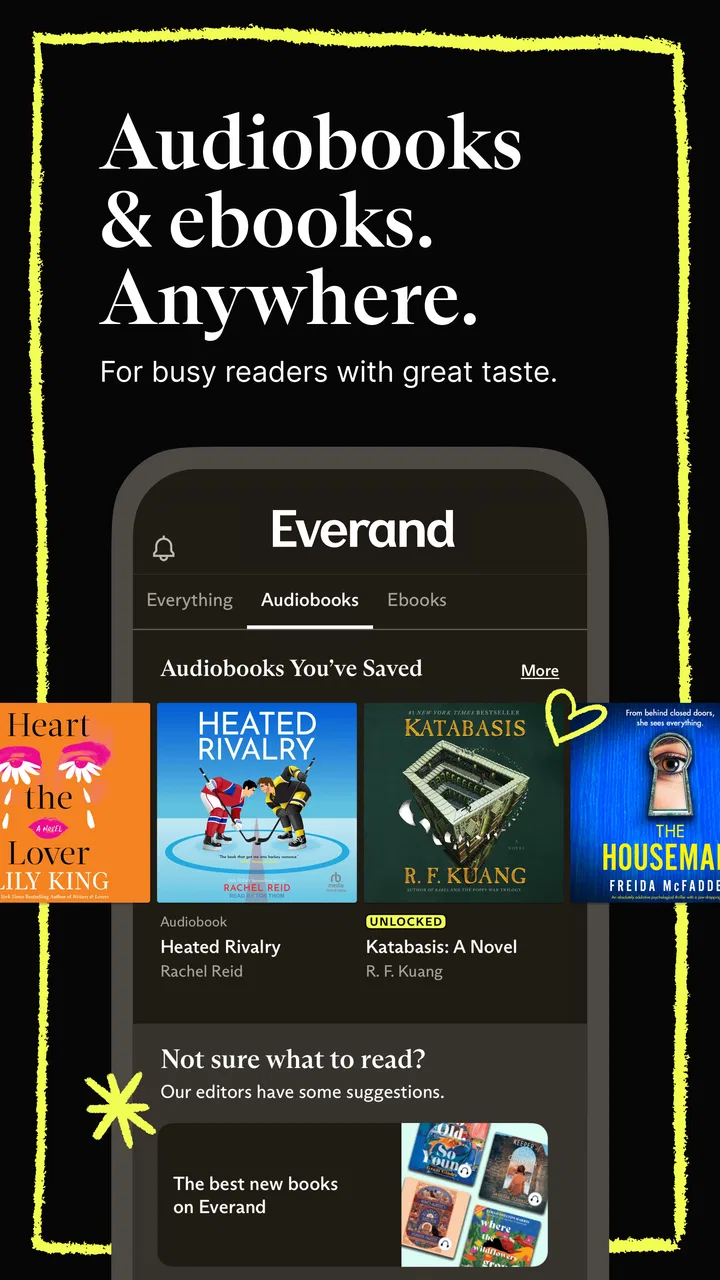
Everand: Audiobooks & Ebooks
- 3.5
- Rating
- 10.00M
- Installs
- Free
- Price

 Analysis by App-foxy
Everand: Audiobooks & Ebooks feels most useful when reading time is irregular. I can open an ebook during a quiet lunch, switch to an audiobook while doing chores, and keep both activities inside one Books & Reference app instead of managing separate services. That flexibility is the main reason I would recommend trying it, but it is also what makes the long-term question important: a large subscription library only earns its place if I continue using it after the first burst of curiosity.
Developed by Scribd, Inc., this free app is aimed at Everyone and runs on Android from version 7.1 onward. It has been around since February 17, 2012, and the current version is 16.2. Its store presence is substantial, with more than 10 million installs, although its average rating sits at 3.6 from roughly 616,000 ratings and about 37,000 reviews. Those figures suggest a service many people try, but also one that does not satisfy every reader equally.
What using Everand feels like beyond the first download
I find that the app’s usefulness becomes clearer once the novelty of browsing wears off: the real question is whether its mix of text and audio fits the way I read on an ordinary day. I would pay attention not just to what I can open, but to how comfortably I can navigate, listen, and return to a book in different settings. That perspective also makes it easier to notice where flexibility helps—and where a different reading setup may work better.
You May Also Like

 Blood Strike: 2.5 Anniversary
Blood Strike’s Loadouts Turn Every Drop Into a Tactical Gamble
A close look at Blood Strike’s custom loadouts: how fast access to signature weapons reshapes its battle royale rhythm, rewards preparation, and narrows the gap between fights.

 Pandora - Music & Podcasts
Pandora’s Music Is Easy to Start, but Harder to Recover
Pandora’s strength is its low-effort path from a seed to a station. Its weak spot is how much confidence it asks you to place in connection, setup, and quiet recovery.

 8 Ball Pool
 Is Built on Rivalries, Rematches, and Routine
A close look at the rivalries, rematches, shared routines, and unanswered safety questions that turn a quick pool match into a persistent mobile community.

 Samsung Music
’s Quiet Strength Is Playing What You Already Own
Its reach comes less from spectacle than from dependable access to a personal library. That simplicity is both the app’s strongest retention engine and its ceiling.

 AccuWeather: Weather Radar
AccuWeather Review: A Quick, Clear Forecast for Everyday Decisions
For everyday plans, the best forecast is the one you can understand quickly. AccuWeather makes rain timing, radar, and local conditions easy to act on, with a few trade-offs.

 Hill Climb Racing
Why Hill Climb Racing Still Turns Crashes Into One More Run
A tiny car, a bumpy hill and one more upgrade: Hill Climb Racing keeps resurfacing because its simple chaos makes every near-miss feel personal.
More From Our News Desk



The first week is about testing your real reading habits
My first recommendation is not to treat the opening week as a hunt for the biggest titles. Instead, I would use it to test three different situations: reading on a phone, listening with headphones, and returning to a book after a gap. That reveals more than browsing a long catalog. A service like this succeeds when it fits naturally into small spaces in the day, not only when I have a free evening and a strong desire to begin something new.
The combination of audiobooks and ebooks gives the app a practical advantage over a traditional single-format reading library. An audiobook can turn a commute, walk, or kitchen task into reading time, while an ebook is better when I need to skim, reread a passage, or keep the pace under my control. I would not use those formats interchangeably for every title, but having both available makes it easier to keep a reading habit alive when my schedule changes.
A useful early workflow is to create a short personal queue rather than saving everything that looks interesting. I would choose one book for focused reading, one audiobook for routine tasks, and perhaps a lighter backup. This prevents the familiar subscription problem where an enormous selection becomes a source of indecision. The app is more valuable when it reduces the time between deciding to read and actually starting.
The first week is also when I would check whether the app’s presentation suits my eyes and ears. Reading on a small screen is comfortable for some people and tiring for others. Likewise, audiobook enjoyment depends on narration style, listening speed, and the kind of attention I can give while moving around. These are personal trade-offs, but they matter more than a catalog headline. A service can contain appealing books and still fail if its main formats do not fit my routine.
Why the mixed format matters in an ordinary day
Imagine a weekday in which I have ten minutes before work, a repetitive household task in the evening, and only a short window before bed. I might read a few pages in the morning, listen later, and return to text at night. That pattern is more realistic than promising myself an uninterrupted hour. Everand’s strongest first impression comes from making reading adaptable rather than demanding a specific kind of free time.
There is a second, less obvious benefit to this approach: switching formats can protect a book from being abandoned for the wrong reason. If my attention is poor while reading after dinner, I can listen instead. If an audiobook feels too slow for a complicated section, text may be better. I still need to decide whether changing formats helps me understand the work, rather than simply giving me another way to postpone it.
For readers who already own a carefully organized collection, the appeal is different. Everand is not necessarily a replacement for books purchased elsewhere. I see it more as a discovery and access layer, especially for people who want to sample different subjects without committing to each title individually. That distinction is important because a subscription library and a permanent personal library solve different problems.
The subscription question appears immediately
The app itself is free to install, but the experience is connected to in-app purchases ranging from $0.99 to $19.99 per item. I would pay close attention to the purchase screen and the terms shown before committing, because the value depends on how often I actually use the service. A low-friction start can make a subscription feel inexpensive in the moment, while the real cost is the collection of months in which I barely open it.
That does not make the model unsuitable. It simply means I would judge it by completed books and listening hours, not by the number of titles I saved. If I regularly finish books through it, the subscription can feel more sensible than buying every experiment individually. If I mostly browse, the same catalog becomes an expensive shelf of intentions.
Month-to-month value depends on a repeatable routine
After the novelty fades, I would keep Everand only if it supports a dependable habit. My own test would be simple: do I open it because I already know when it belongs in my day, or only because I remember that I am paying for it? The difference is crucial. A useful reading service should become part of a routine, such as listening during a regular walk or reading a few pages before sleep.
The mixed catalog helps here because one format can take over when another becomes inconvenient. Still, variety alone does not create commitment. I need a manageable way to choose the next book, and I need to avoid filling my saved list with titles I will never start. I would periodically remove abandoned choices and keep only books connected to an immediate interest. This small maintenance habit makes the service feel calmer and more intentional.
For a curious reader, the strongest recurring value is the ability to explore beyond a narrow comfort zone. I can try a subject, author, or format without turning every trial into a separate purchase. That is especially useful when I am unsure whether I want a full book or only a short introduction to a topic. The trade-off is that exploration can replace completion, so I would set a rule for myself: finish a book before starting several new ones unless the current choice is clearly not working.
Families and shared households should think carefully about how they expect to use it. The app may be appealing when different people have different tastes, but a broad catalog does not automatically mean every person will find equal value. One person who listens daily can justify the service more easily than several occasional users who each browse briefly. I would base the decision on actual household habits rather than the number of people who might theoretically use it.
How it compares with buying books or using a single-format app
Buying individual ebooks is better when I want permanent ownership of specific titles and expect to reread them. A personal collection also feels more predictable: I know what remains available to me because I paid for that particular book. Everand is stronger when I value breadth, experimentation, and the ability to move between text and audio without purchasing every choice separately.
A dedicated audiobook service may be preferable for someone who listens almost exclusively and cares most about an audio-first experience. In the same way, an ebook-focused reader may prefer a platform designed around typography, long reading sessions, and a permanent digital library. Everand’s advantage is not that it wins every format comparison; it is that it combines formats in one place for people whose habits are mixed.
There is also a difference between convenience and control. A subscription is convenient because I can explore broadly, but it gives me less certainty than owning a file or a physical book. If a title is central to my personal library, I would consider buying it separately even if I first discover it through Everand. That approach treats the app as a discovery tool and reading companion rather than assuming it must replace every other source.
The maintenance burden is modest, but real
Everand does not require constant attention, yet a good experience benefits from occasional housekeeping. I would keep the saved list short, remove books that no longer interest me, and check whether my current queue still reflects the time I actually have. Without that effort, the app can become visually crowded with unfinished intentions, which makes opening it feel like another task.
My practical routine would be to choose the next audiobook before a commute and the next ebook before a quiet reading session. That avoids making decisions when I am already tired. I would also keep notes outside the app for books I genuinely want to remember, particularly if they matter for study or work. A subscription reader is convenient for access, but I would not rely on it alone as a permanent knowledge archive.
Another maintenance issue is attention management. Notifications, recommendations, and a large selection can encourage constant browsing. I would treat recommendations as prompts, not obligations. If I spend more time comparing titles than reading or listening, the service is no longer serving my habit. The best result comes from entering with a purpose and leaving once I have chosen something suitable.
Where fatigue begins after repeated use
The first source of fatigue is choice overload. A wide library sounds generous, but it can make every session begin with a search. This is why a small queue matters. I would rather have three realistic options than dozens of attractive possibilities, especially when I am using the app during a short break.
The second is format mismatch. Audiobooks are excellent when my hands and eyes are occupied, but they are not ideal for every subject. Dense nonfiction, reference material, or books I need to quote may be easier in text. Conversely, a long novel can feel more approachable in audio when I am too tired to read. Everand gives me options, but it does not remove the need to choose the right format for the material.
The third is the emotional friction of a subscription library. I may become invested in a book and then worry about whether I will return to it later, especially if I think of my reading collection as something permanent. That concern does not ruin the service, but it changes how I use it. For books I expect to revisit for years, ownership still has a clear advantage.
There can also be fatigue from abandoning books. Because trying another title is easy, I might switch too quickly whenever a chapter slows down. I would distinguish between a book that needs patience and one that genuinely does not suit me. Giving a title a fair, defined trial is better than treating every moment of boredom as a reason to browse again.
Who will get the most from it
I think Everand is a good match for readers who move between ebooks and audiobooks, enjoy discovering unfamiliar subjects, and can maintain a regular reading or listening routine. It is particularly appealing when I want flexibility more than ownership. People with changing schedules may appreciate that reading can fit around errands, travel, exercise, or quiet time at home.
It is less convincing for someone who reads only a few books a year, wants to own every title permanently, or already has a focused audiobook or ebook service that matches their habits perfectly. It may also disappoint readers who expect every desired book to be available at the moment they search for it. A large service can still be the wrong service if its selection does not match my specific interests.
The age rating of Everyone makes the app broadly approachable, but that does not mean every book suits every reader. I would still judge individual titles by their subject matter and intended audience, especially when choosing something for a younger reader. The app’s general rating is not a substitute for checking the content of a particular book.
What I would do before keeping it long term
I would begin by identifying one repeatable listening slot and one repeatable reading slot. Then I would select titles that fit those slots instead of choosing books based only on ambition. A short commute favors a book that can be followed in segments; bedtime favors text that is easy to pause; household tasks favor audio that does not require visual attention.
I would also compare the service with my actual spending pattern, not an imagined ideal month. If I normally buy one book occasionally and rarely use audio, a subscription may not be the best financial choice. If I regularly sample books, finish them, and use both formats, the recurring access becomes easier to justify. The important measurement is consistent use, not the impressive size of the library.
Finally, I would give myself permission to leave if the habit does not form. Keeping an app because it might become useful later is different from using it now. Everand earns a lasting place when it helps me read more often or more flexibly, not merely when it gives me another catalog to browse.
My long-term verdict
Everand: Audiobooks & Ebooks has a convincing everyday purpose: it brings reading and listening together for people whose schedules do not stay consistent. I like the freedom to change formats according to the moment, and I see real value in exploring books without treating every experiment as a permanent purchase. The app is at its best when I use it deliberately, with a short queue and a clear routine.
Its weaknesses are tied to the same model that makes it attractive. Selection can create indecision, subscriptions can encourage passive browsing, and access is not the same as ownership. Readers who want a permanent, carefully controlled library may prefer buying individual ebooks or audiobooks. Readers committed to only one format may also find a specialized alternative more focused.
For me, the lasting verdict is conditional but positive. I would keep it if I were finishing books through both audio and text each month, especially during periods when my free time changed from day to day. I would skip it if I mostly saved titles, rarely returned, or needed dependable ownership of a small personal collection. The novelty is easy to enjoy; the real test is whether Everand quietly becomes part of the week. When it does, its flexibility is meaningful. When it does not, the subscription is simply another source of digital clutter.
FAQs for Everand: Audiobooks & Ebooks
01What types of content does Everand: Audiobooks & Ebooks offer?
Everand provides a diverse library of both audiobooks and ebooks across various genres, including fiction, non-fiction, self-help, and more. Users can explore bestsellers, classic literature, and exclusive content tailored to different interests and age groups. The app updates regularly, ensuring fresh content for readers and listeners.
02Is there a subscription fee to use Everand?
Yes, Everand operates on a subscription model, granting users unlimited access to its extensive library. While there may be a free trial period available, ongoing access requires a monthly or annual fee. Subscription plans often include additional benefits such as offline downloads and personalized recommendations.
03Can I access content offline with Everand?
Absolutely. Everand allows users to download audiobooks and ebooks for offline access. This feature is particularly useful for those who wish to enjoy their content without an internet connection, such as during travel. Downloaded content remains accessible as long as the subscription is active.
04What devices are compatible with Everand?
Everand is compatible with both Android and iOS devices, including smartphones and tablets. The app is optimized for various screen sizes, ensuring a seamless reading and listening experience. Users can also sync their progress across multiple devices, making it easy to pick up where they left off.
05Are there parental controls available in Everand?
Yes, Everand includes parental control features to ensure a safe environment for younger users. Parents can set restrictions on certain content types and monitor their children's reading and listening activities. This makes it a family-friendly app suitable for all age groups, providing peace of mind for parents.
Pros
- User-friendly interface for easy navigation.
- Extensive library of audiobooks and ebooks.
- Offline access to saved books.
- Customizable reading and listening settings.
- Regular updates with new content.
Cons
- Limited free content available.
- Requires internet for initial downloads.
- Some audiobooks lack chapter markers.
- Subscription needed for premium features.
- Occasional bugs in the search function.

Everand: Audiobooks & Ebooks
Gallery